
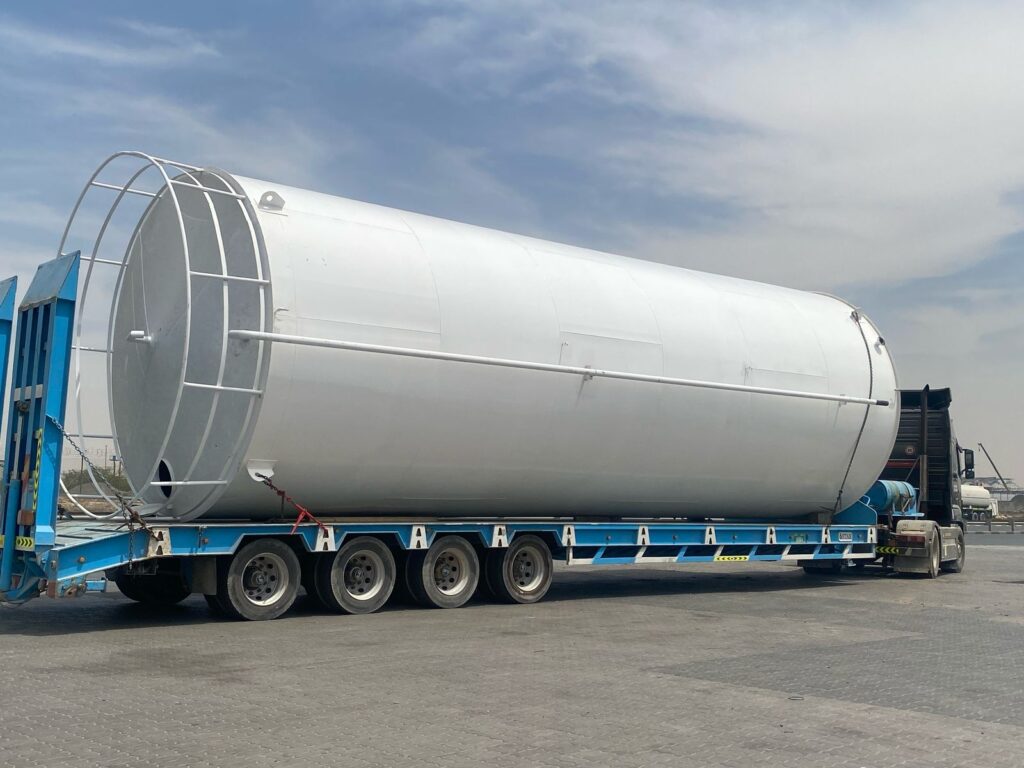
Short answer: use API 650 for large, site-built steel tanks that store oil, diesel, water or chemicals at (near) atmospheric pressure; use API 620 when the tank has to hold a higher internal pressure, up to about 15 psig, or very low temperatures; and use UL 142 for smaller, shop-fabricated aboveground tanks for flammable and combustible liquids, such as generator diesel tanks. In the UAE, the standard your consultant, client or Civil Defence approval asks for always takes priority.
This guide explains what each standard covers, how they differ and how to pick the right one for a tank project in the UAE or the wider GCC.
API 650: welded steel tanks for oil storage
API 650 (Welded Tanks for Oil Storage, published by the American Petroleum Institute) is the most widely used standard for large vertical, cylindrical, aboveground storage tanks. It is used far beyond oil: refineries, fuel depots, power plants, desalination and water projects, and chemical plants all specify it.
- Pressure: atmospheric, or a small internal pressure of up to 2.5 psig (about 17 kPa) under its pressure annex.
- Construction: usually field-erected from plates on a prepared foundation, with fixed cone or dome roofs, or open-top tanks with floating roofs.
- Size: from a few metres in diameter up to very large terminal tanks.
- Typical uses: crude and refined products, diesel and fuel oil, bitumen (with heating and insulation), firewater, process water and many chemicals.
Once in service, API 650 tanks are normally inspected, repaired and altered under API 653.
API 620: large low-pressure storage tanks
API 620 (Design and Construction of Large, Welded, Low-Pressure Storage Tanks) covers tanks that must hold more pressure than API 650 allows but less than a pressure vessel.
- Pressure: internal pressures above API 650’s limit, up to 15 psig (about 103 kPa).
- Temperature: its annexes cover refrigerated storage at very low temperatures, such as liquefied gases.
- Design: more detailed stress analysis, often with curved roofs and bottoms, and stricter testing than API 650.
- Typical uses: refrigerated and low-pressure gas storage, and products with vapour pressure that would exceed an API 650 tank.
Above 15 psig the tank is no longer a storage tank in this sense and is designed as a pressure vessel, usually to ASME Section VIII.
UL 142: shop-built aboveground tanks for flammable liquids
UL 142 (Steel Aboveground Tanks for Flammable and Combustible Liquids, from UL Solutions) covers smaller tanks built in a workshop and delivered complete to site.
- Pressure: atmospheric.
- Construction: horizontal or vertical, cylindrical or rectangular, single-wall or double-wall (secondary containment).
- Size: limited to shop-fabricated sizes (up to 50,000 US gallons, roughly 190,000 litres).
- Typical uses: generator day tanks and bulk diesel tanks, fuel stations, workshops and sites that need a listed, ready-to-install tank.
Related standards include UL 2085 for protected and fire-resistant tanks and UL 58 for underground steel tanks.
API 650 vs API 620 vs UL 142 at a glance
| API 650 | API 620 | UL 142 | |
|---|---|---|---|
| Internal pressure | Atmospheric to 2.5 psig | Up to 15 psig | Atmospheric |
| Where it is built | Mostly field-erected | Field-erected | Workshop, delivered complete |
| Size range | Medium to very large | Large | Small to medium (up to 50,000 US gal) |
| Typical liquids | Oil, diesel, water, chemicals, bitumen | Low-pressure and refrigerated products | Diesel and other flammable or combustible liquids |
| Typical project | Tank farms, depots, plants | Gas and special process storage | Generator, fuel station and site tanks |
How to choose for a UAE project
- Start with the specification. If the consultant, end client (for example an oil company or utility) or tender documents name a standard, use it.
- Check pressure and temperature. Atmospheric storage points to API 650 or UL 142; up to 15 psig or refrigerated storage points to API 620; higher pressure means a pressure vessel.
- Check the size and site. If the tank can be built in a workshop and transported, UL 142 or a shop-built API 650 tank is often faster and cheaper. Large tanks are built on site.
- Check approvals. Diesel and fuel tanks generally need Civil Defence approval in the emirate where they are installed. Confirm early which standard, wall type (single or double) and accessories the approval expects.
- Plan for inspection. Ask for material certificates, welding procedures, NDT and hydrotest records, so the tank can be inspected later under API 653 or the owner’s own procedure.
Frequently asked questions
Can a diesel tank be built to API 650 instead of UL 142?
Yes. Large diesel storage tanks are commonly built to API 650. UL 142 is mainly used for smaller, shop-built tanks where a listed tank is required. Check what your approval authority and client accept.
Is API 620 better than API 650?
Not better, just for a different job. API 620 is needed only when the tank must hold higher internal pressure or very low temperature. For normal atmospheric storage it adds cost without benefit.
Which standard applies to water and firewater tanks?
Steel water and firewater tanks in the region are often designed to API 650. Some projects specify AWWA D100 or other standards, so follow the project specification and the fire-protection consultant.
What comes after the tank is installed?
API 650 tanks are normally inspected, repaired and altered under API 653. Keep the fabrication records so inspections and future modifications are straightforward.
Need a tank built to a specific standard?
Rukn Al Mizan fabricates storage tanks, batching units, pressure vessels and steel structures from its workshop in Sajja Industrial Area, Sharjah. Send us the liquid, capacity, design pressure and the standard named in your specification, and we will advise and quote. See our storage tank fabrication and pressure vessel fabrication services, or contact us on +971 50 430 2562.
